


Ready to Serve!
Ready to Serve!
Charging and Discharging of
Capacitor Project Class 12 pdf
INTRODUCTION
An R-C circuit is a circuit containing a resistor and capacitor in series to a power source. Such circuits Find very important applications in various areas of science and in basic circuits which act as building blocks of modern technological devices.
It should be really helpful if we get comfortable with the terminologies charging and discharging of capacitors.
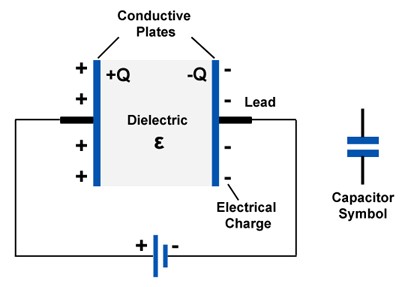
A capacitor is a passive two-terminal electrical component used to store energy in an electric field. In the hydraulic analogy, charge carriers lowing through a wire are analogous to water flowing through a pipe. A capacitor is like a rubber membrane sealed inside a pipe. Water molecules cannot pass through the membrane, but some water can move by stretching the membrane. The analogy clarifies a few aspects of capacitors:
Using hydraulic analogy only we can understand that when the capacitor is charged the membrane is stretched, but now if you allow the water to come out slowly and let the membrane relax, then it is called discharging of capacitor. In other words, when the charge on each of the plates becomes zero and the potential difference across its terminals drops to zero.
AIM
To verify that 63% charge is stored in a capacitor in a R-C circuit at its time constant and 63% charge remains when capacitor is discharged and hence plot a graph between voltage and time
COMPONENTS REQUIRED
THEORY
When a capacitor of capacitance C is connected in series with a resistor of resistance R and then connected to a battery of EMF E it gets charged but since some resistance has been introduced, this charging process takes some time and hence the potential difference between the plates of the capacitor varies as an exponential function of time, i.e.
V α ext
The circuit diagram for this experiment is given below: –
Applying KIRCHHOFF’S LAW in the above circuit during charging i.e. Capacitor is connected to battery
…………………………(i)
CONCLUSION
Hence it is verified experimentally that 63% charge is there on capacitor after time constant during charging and 63% charge is lost at time constant during discharging.
CAPACITOR DIAGRAM
CONSTRUCTION
BIBLIOGRAPHY