
To Study the Common Food Adulterants in Fat, Oil, Butter, Turmeric Powder, Chili Powder and Pepper Project PDF Class 12

Aim
To study the common food adulterant in fat, oil, butter, turmeric powder, chilli powder and pepper
Introduction
Food is the basic necessity of life, and the quality of the food we consume plays a vital role in maintaining good health. Unfortunately, in today’s world, food adulteration has become a serious concern as many food substances are intentionally contaminated for economic benefit. Although food processing and preservation techniques existed since prehistoric times, the problem of adulteration significantly increased during the Middle Ages when substances like nutshells, stones, dust, chalk, plaster and even toxic metals such as lead were mixed with various food items to enhance their appearance and quantity. By the end of the 19th century, advancements in industrialization and chemistry allowed manufacturers to mask food deterioration in ways that became more difficult to detect, giving rise to the widespread use of chemical additives and artificial colourants. In the modern era, the high demand for packaged food products and competitive markets has further encouraged the unethical practice of adulteration.
Essential food items like fat, oil, butter, turmeric powder, chilli powder and pepper are among the most commonly adulterated products. These adulterants not only reduce the nutritional value of food but also pose serious health risks, including digestive problems, organ damage, food poisoning and long-term diseases. Therefore, it is important to create awareness and investigate the presence of adulterants in everyday food items. This project aims to study and identify the common adulterants present in fats and oils, dairy products like butter, and commonly used spices such as turmeric powder, chilli powder and pepper.
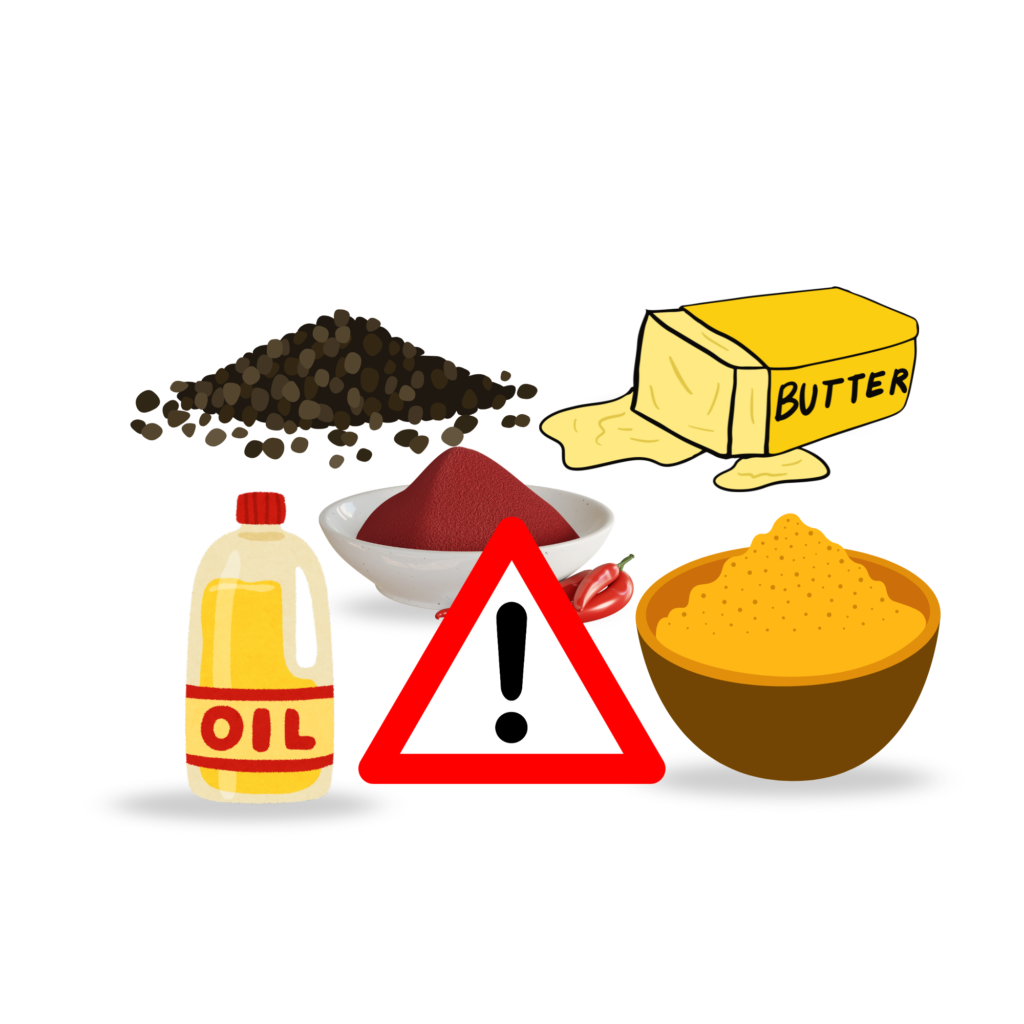
ADULTERANTS IN COMMON FOOD
Most adulterants are cheap and easily available substitutes added intentionally to increase profit, even though they reduce food quality and harm health. Some common examples are:
- Fats, oils and butter adulterated with paraffin wax, castor oil and hydrocarbons to increase volume and thickness.
- Chilli powder and turmeric powder mixed with brick powder and yellow lead chromate to give bright colour and attractive appearance.
- Sugar contaminated with washing soda or powdered chalk to increase weight and improve texture.
- Pepper adulterated with dry papaya seeds, which look similar to peppercorns but lack flavour.
IMPACT OF ADULTERANTS
- Consumption of adulterated food can cause stomach pain, vomiting, diarrhoea, body ache, anaemia and abnormalities the skin and eyes due to harmful toxic substances.
- Long-term intake of adulterated food may lead to chronic diseases such as heart problems, asthma, liver and kidney damage and overall weakening of the immune system.
- Some adulterants including heavy metals like lead and mercury can damage the nervous system, causing paralysis, memory loss, reduced concentration and development issues in children.
- Adulterated spices, oils and dairy products can result in cancer, formation of tumours and hormonal imbalance, leading to serious long-term health complications.
IMPORTANCE OF DETECTING FOOD ADULTERATION
- Prevents the consumption of harmful chemicals, toxic dyes, and non-permitted preservatives added to food.
- Reduces the risk of long-term health problems such as cancer, kidney damage, liver disorders, and hormonal imbalance.
- Protects vulnerable groups like children, pregnant women, and elderly people from severe health effects.
- Helps government agencies monitor food quality and take legal action against offenders.
- Encourages manufacturers to follow safety regulations and good manufacturing practices (GMP).
- Aids in early detection of adulterated food before it reaches large populations.
- Supports implementation of food safety laws such as FSSAI standards.
- Improves overall nutritional value of food by preventing dilution or substitution with inferior materials.
- Increases awareness among consumers to check food quality at home using simple tests.
Prevents economic loss to consumers by ensuring they get value for money.
GOVERNMENT LAWS
The Government of India has established strict laws and regulations to protect consumers from adulterated and unsafe food. These laws ensure that food products sold in the market meet safety and quality standards. Some important provisions are:
✔ Prevention of Food Adulteration Act (PFA), 1954: This was one of the earliest laws to control food adulteration in India. It aimed to prevent the sale of food items that were impure, unsafe or misbranded.
✔ Food Safety and Standards Act (FSSA), 2006: This act replaced the PFA and combined all previous food-related laws under one system. It was created to ensure the availability of safe, wholesome and good-quality food for consumers.
✔ Food Safety and Standards Authority of India (FSSAI): Formed under the FSSA, FSSAI is the main authority responsible for monitoring and regulating food safety. It issues food licences, sets quality standards, checks food labels and takes action against the sale of adulterated food.
✔ Punishments and Penalties: The government has set strict penalties for food adulteration, including heavy fines, cancellation of food licences, imprisonment and compulsory product recall. Penalties are higher if the adulteration causes serious illness or endangers life.
Experiment-1
Aim-
To detect the presence of adulterants in fat, oil and butter
Apparatus Required-
Test-tube, acetic anhydride, conc. , acetic acid, conc.
Procedure-
Common adulterants present in ghee and oil are paraffin wax, hydrocarbons, dyes and argemone oil. These are detected as follows:
- Adulteration of paraffin wax and hydrocarbons in vegetable ghee:
Heat small amount of vegetable ghee with acetic anhydride. Droplets of oil floating on the surface of unused acetic anhydride indicates the presence of wax or hydrocarbons. - Adulteration of dyes in fat:
Heat 1ml of fat with a mixture of 1ml of concentrated Sulphuric acid and 4ml of acetic acid. Appearance of pink or red colour indicates presence of dye in fat. - Adulteration of argemone oil in edible oils:
To small amount of oil in a test-tube, add few drops of concentrated and shake. Appearance of red colour in the acid layer indicates presence of argemone oil.
Experiment-2
Aim-
To detect the presence of adulterants in sugar
Apparatus Required-
Test-tubes, dilute hydrochloric acid
Procedure-
Sugar is usually contaminated with washing soda and other insoluble substances which are detected as follows:
- Adulteration of various insoluble substances in sugar:
Take small amount of sugar in a test-tube and shake it with little water. Pure sugar dissolves in water but insoluble impurities do not dissolve.
Adulteration of chalk powder, washing soda in sugar:
To small amount of sugar in a test-tube, add few drops of HCl. Brisk effervescence of shows that the presence of chalk powder or washing soda in the given sample of sugar.
Experiment-3
Aim-
To detect the presence of adulterants in samples of chilli powder, turmeric powder and pepper
Apparatus Required-
Test-tubes, concentrated hydrochloric acid, dilute nitric acid, KI solution
Procedure-
Common adulterants present in chili powder, turmeric powder and pepper are red coloured lead salts, yellow lead salts and dried papaya seeds respectively. They are detected as follows:
- Adulteration of yellow lead salts to turmeric powder:
To a sample of turmeric powder add concentrated Hydrochloric acid. Appearance of magenta colour shows the presence of yellow oxides of lead in turmeric powder. - Adulteration of red lead salts in chilli powder:
To a sample of chilli powder, add diluted Filter solution and add 2 drops of potassium iodide solution to the filtrate. Yellow ppt. indicates the presence of lead salts in chilli powder. - Adulteration of brick powder in red chilli powder:
Add small amount of given red chilli powder in beaker containing water. Brick powder settles at the bottom while pare chili powder floats over water. - Adulteration of dried papaya seeds in pepper:
Add small amount of sample of pepper to a beaker containing water and stir with a glass rod, dried papaya seeds being lighter float over water while pure pepper settles at the bottom.
Observation
S.No | Experiment | Procedure | Observation |
1 | Adulteration of dyes in fat | Heat 1ml of fat with a mixture of 1ml of conc. and 4ml of acetic acid | Appearance of pink colour |
2 | Adulteration of argemone oil and edible oils | Adulteration of argemone oil and edible oils | No red colour observed |
3 | Adulteration of various insoluble substances in sugar | To small amount of sugar in a test tube, add some water and shake | Pure sugar dissolves in water but insoluble impurities do not dissolve |
4 | Adulteration of chalk powder, washing soda in sugar | To small amount of sugar in test tube, add few drops of dil. HCl | No brisk effervescence observed |
5 | Adulteration of yellow lead salts to turmeric powder | To sample of turmeric powder, add conc. HCl | Appearance of magenta colour |
6 | Adulteration of red lead salts in chilli powder | To sample of chilli powder, add dil. . Filter the solution and add 2 drops of KI solution to the filtrate | No yellow precipitate |
7 | Adulteration of brick powder in chilli powder | Add small amount of given red chilli powder in a beaker containing water | Brick powder settles at the bottom while pure chilli powder floats over water |
8 | Adulteration of dried papaya seeds in pepper | Add small amount of sample of pepper to beaker containing water and stir with a glass rod | Dried papaya seeds being lighter floats over water while pure pepper settles at the bottom |
Result
The essential oils were successfully extracted from Saunf (Aniseed), Ajwain (Carom), and Elaichi (Cardamom) using the method of steam distillation. The percentage yield and physical characteristics of the oils were observed as follows:
Plant Material | Weight Taken | Oil Extracted | Percentage Yield | Colour | Odour |
Saunf (Aniseed) | 100 gm | 1.25 gm | 1.25% | Colourless | Saunf-like |
Ajwain (Carom) | 75 gm | 1.00 gm | 1.33% | Colourless | Ajwain-like |
Elaichi (Cardamom) | 100 gm | 1.25 gm | 1.25% | Colourless | Elaichi-like |
Conclusion
This investigatory project clearly demonstrates that many commonly used food items such as fats, oils, butter, sugar, turmeric powder, chilli powder and pepper are highly susceptible to adulteration. Through simple laboratory tests, adulterants like paraffin wax, hydrocarbons, dyes, yellow lead salts, brick powder and dried papaya seeds were successfully identified in the respective samples, while some food items showed no signs of adulteration. These results highlight the seriousness of food adulteration and the potential health risks associated with consuming contaminated food.
Selection of wholesome and non-adulterated food is essential for maintaining good health. While many toxic adulterants may be present at very low (ppm) levels and cannot be detected through visual inspection alone, careful examination at the time of purchase can help identify visible impurities such as insects, fungus or foreign particles. Reading label information on packaged foods is equally important, as it helps check the ingredients, nutritional value, manufacturing date and expiry date, ensuring the product’s freshness and safety. Consumers should avoid food prepared or sold under unhygienic conditions, as well as cut fruits exposed to open air, since such foods may lead to various diseases.
Precautions
- Always purchase food items that are properly packed and manufactured by well-known and trusted companies.
- Buy food products only from reliable retail shops and recognised outlets.
- Check for quality certification marks such as ISI, AGMARK, and FSSAI licence number/logo on packaged food items.
- Prefer airtight, sealed packages of popular and reputed brands to minimise the risk of contamination.
- Avoid purchasing brightly coloured or artificially attractive sweets and food items, especially from unknown sellers.
- Do not buy sweets, snacks or food items that are kept uncovered or exposed to dust, insects and flies.
Avoid buying food items from roadside vendors and unhygienic places, as proper food safety standards may not be followed.
Project PDF Download Link:
